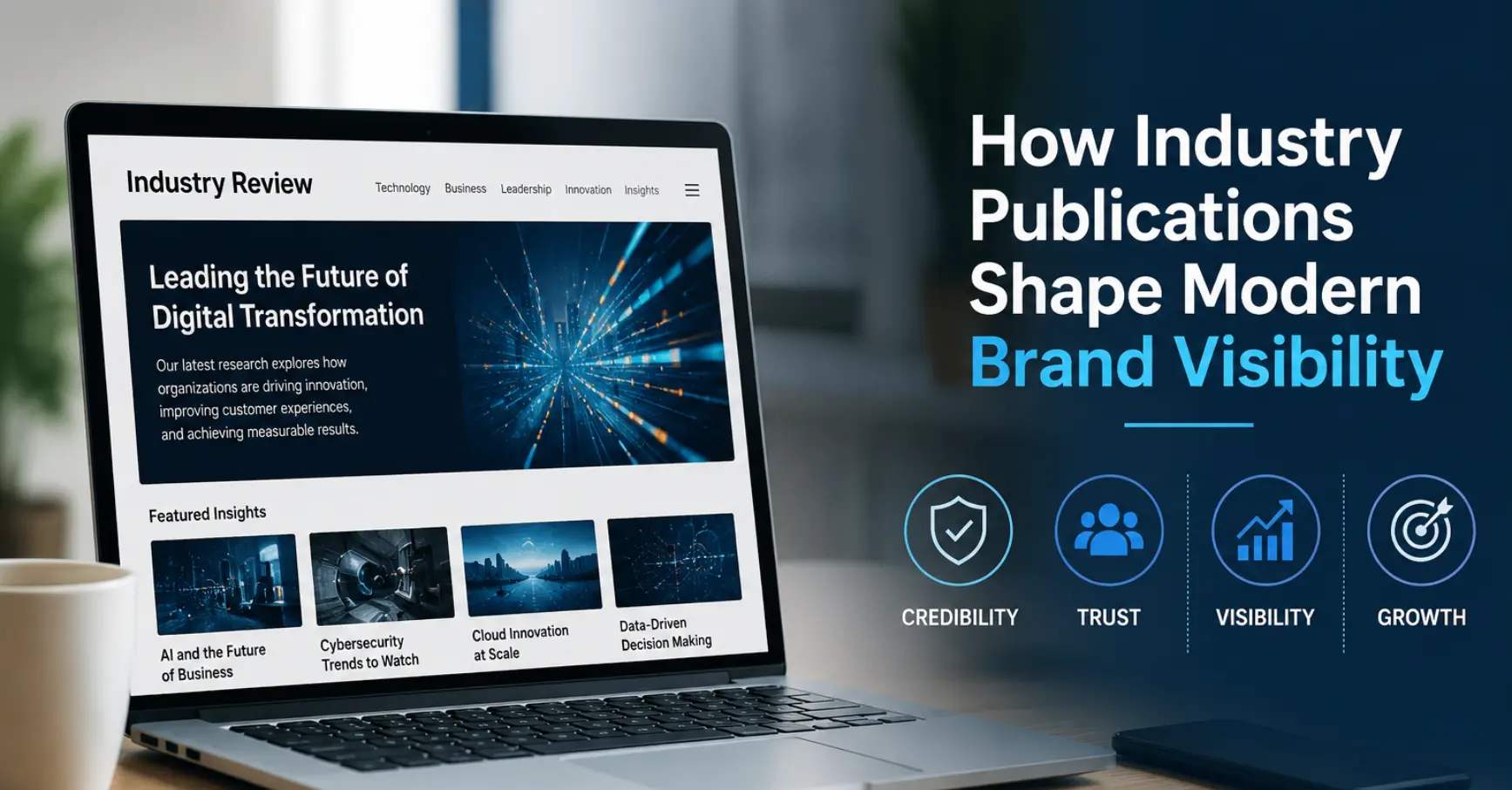
There's a reason the most respected companies in the world still care deeply about getting featured in the right publications — and it's not nostalgia. In an era where anyone can run a paid ad campaign or publish a LinkedIn post in minutes, editorial coverage in a respected industry publication carries something that money alone can't buy: credibility.
Think about the last time you made a significant purchase decision - whether personal or professional. Chances are, you didn't just trust the brand's own website. You looked for third-party validation. You read reviews, checked what experts were saying, maybe even came across a feature in a tech outlet or trade journal. That's the quiet, compounding power of industry publications at work
According to a study by Edelman and LinkedIn, 65% of B2B buyers say thought leadership content has directly influenced their decision to purchase a product or service. And where does that thought leadership most often live? In trusted publications. This isn't a coincidence - it's a blueprint. Let's dig into how industry publications are shaping modern brand visibility, why they matter more than ever, and how brands - especially in the technology sector - can use them strategically.
What Are Industry Publications - And Why Do They Still Matter?
Industry publications are media outlets that serve a specific professional audience. They range from long-established print trade journals that have gone digital, to modern-born online outlets covering everything from Information Technology to Emerging Technologies to data science.
Unlike general news platforms, these publications are deeply trusted by their readers because they speak a specific language, address specific pain points, and are curated by editors who genuinely understand the field. An IT Magazine isn't talking to everyone — it's talking to CTOs, IT directors, developers, and enterprise decision-makers. That specificity is exactly what makes it so valuable.
And no, these publications haven't been made irrelevant by social media. If anything, the opposite is true. As social feeds became noisier and harder to trust, people migrated toward authoritative sources. A feature in a well-regarded Technology Magazine or Cybersecurity Magazine still carries the kind of weight that a sponsored tweet simply cannot replicate.
The landscape has evolved, certainly. Most top-tier publications now operate as robust digital platforms — complete with newsletters, podcasts, webinars, and social syndication. But the core value proposition remains: editorial credibility.
The Trust Economy: How Publications Build Brand Credibility
Here's the fundamental difference between a paid ad and an editorial feature: one is bought, the other is earned
When a respected AI Magazine writes about your company's innovation, or a top Cybersecurity Magazine quotes your CISO in a feature about ransomware trends, something powerful happens. The publication's credibility becomes associated with your brand. Researchers call this the "halo effect" — and it's very real in B2B marketing.
Consider Palo Alto Networks, one of the world's leading cybersecurity companies. Long before they became a household name in enterprise security, they were consistently appearing in niche cybersecurity and Information Technology publications. Their executives were quoted as experts. Their research was cited. That consistent editorial presence built a layer of trust that advertising budgets couldn't have purchased as efficiently.
The same pattern plays out across Cloud Computing, Enterprise Technology, and Data Analytics — industries where buyers are sophisticated, cycles are long, and trust is everything. In these spaces, a company that gets regular, meaningful coverage in respected Technology News outlets builds a kind of brand equity that's almost impossible to replicate through other channels.
How Digital Transformation Changed the Publication Landscape
Digital Transformation didn't just change how companies operate - it fundamentally reshaped how publications work and how brands can leverage them.
The shift from print to digital opened up several new dimensions of value. First, there's discoverability. A feature in a printed magazine from 2010 is effectively invisible today. A feature in a well-optimized digital publication from 2020 can still be driving qualified traffic to a brand's website years later. Search engines reward content on authoritative domains, and a backlink from a leading IT News or Technology News platform is genuinely valuable real estate in the SEO landscape.
Second, digital transformation created an explosion of niche, vertical-specific publications. It's now possible to find dedicated outlets for Data Analytics professionals, IT Leadership, cloud architects, AI ethicists, and cybersecurity practitioners - all operating independently and with deeply loyal audiences. This is actually good news for brands: it means there's likely a publication whose audience maps almost perfectly to your ideal customer profile.
Third, publications themselves have adopted Data Analytics and audience intelligence tools to understand what content performs, which topics drive engagement, and how readers move through the funnel. This means editorial decisions are increasingly data driven - which, interestingly, creates more predictable opportunities for brands that understand what these outlets want to publish.
Strategic Placement: What Types of Coverage Actually Move the Needle
Not all press is created equal, and not all types of coverage deliver the same return. Here's how to think about the spectrum:
Thought leadership articles are perhaps the highest-value format. When an executive from your company contributes a bylined article to a respected Enterprise Technology or IT Leadership publication, it accomplishes multiple things simultaneously: it demonstrates expertise, builds personal brand equity for the author, and positions the company as a serious player in the industry conversation.
Executive interviews and profiles in publications like a leading AI Magazine or Technology Trends outlet offer similar benefits with a more human angle. Readers connect with people, not logos — and a well-executed profile piece can humanize a brand while communicating strategic vision.
Case studies and solution features tend to be closer to the bottom of the funnel. A reader who clicks on a deep-dive case study about how a company solved a specific Cybersecurity challenge is often actively evaluating solutions. The conversion intent is high.
Research citations and expert commentary - being quoted in a broader piece - may feel less impactful, but at scale, it's enormously effective. Consistent expert quotation in IT News and Technology News builds a brand as a "go-to source," which compounds over time into genuine authority.
The Low-Volume, High-Conversion Power of Niche Publications
Here's something many marketing teams get wrong: they chase reach over relevance.
A mention in a major generalist outlet sounds impressive in a board presentation. But for a Cybersecurity company selling to enterprise IT departments, a feature in a dedicated Cybersecurity Magazine or IT Leadership publication will almost always produce better actual business outcomes. Why? Because the audience is pre-qualified.
Someone reading a specialized Emerging Technologies publication isn't casually browsing - they're a professional actively seeking to stay current in their field. They're making decisions, evaluating vendors, preparing budget justifications. Their intent is high, and their attention is focused.
This is what marketers call "low volume, high conversion" - niche outlets may have smaller audiences than mass-market tech platforms, but the readers who find your brand through that channel are far more likely to engage meaningfully. In B2B technology markets, this distinction can be the difference between vanity metrics and real pipeline
Smart brands in Cloud Computing and Enterprise Technology are increasingly investing in these niche channels precisely because of this dynamic. The competition for attention in a specialized IT Magazine or Cybersecurity Magazine is lower, the audience is more relevant, and the ROI is demonstrably stronger.
Artificial Intelligence and the Future of Publication-Driven Visibility
It would be impossible to discuss modern brand visibility without acknowledging the seismic impact of Artificial Intelligence - both as a subject matter that publications are covering extensively and as a tool that's reshaping how editorial content is discovered and consumed
AI is transforming the publication landscape in at least two important ways. First, AI powered recommendation engines now play a major role in what content readers see. Publications like leading AI Magazine platforms and Technology Trends outlets are using machine learning to personalize content feeds, meaning the brands that show up consistently in well-structured, high-quality editorial pieces are more likely to be surfaced repeatedly to the right readers.
Second, generative AI tools are changing how editorial teams operate. Publications are using AI to handle research, summaries, and content ideation — which means the human editorial judgment is increasingly focused on high-value, expert-driven content. For brands, this creates an opportunity: original data, proprietary research, and genuine expert perspectives are more valuable than ever because they're what AI tools can't replicate.
According to Technology Trends reports from Gartner, by 2026, over 80% of enterprise technology buyers will rely primarily on AI-curated content journeys during the early stages of vendor evaluation. That journey runs directly through trusted publications. Brands that aren't part of the editorial fabric of their industry's media ecosystem will increasingly be invisible in that journey.
How Brands Can Leverage Industry Publications Effectively
Knowing that publications matter is one thing. Building an effective strategy around them is another. Here's a practical framework for technology brands:
Start with audience mapping. Before pitching anywhere, identify which publications your target buyers actually read. Are they IT directors consuming a daily IT News briefing? Data scientists reading a specialized Data Analytics journal? CISOs following a dedicated Cybersecurity Magazine? The answer determines everything.
Lead with genuine value, not brand promotion. The fastest way to get ignored by an editor is to send a pitch that reads like a press release. The best Technology Magazine and Best Tech Magazine editors are looking for original insights, data, contrarian takes, and expertise that genuinely serves their readers. If your contribution does that, the brand visibility follows naturally.
Build relationships before you need coverage. Media relations is a long game. Follow editors and journalists on LinkedIn. Engage thoughtfully with their published work. Share useful information without any immediate ask. By the time you have something genuinely newsworthy to pitch, you're a known quantity rather than a cold contact.
Be consistent. One feature a year won't build brand visibility. A brand that appears regularly — through contributed articles, expert commentary, research citations, and executive interviews — builds a presence that becomes self-reinforcing. Readers begin to associate the brand with expertise, and editors think of them first when sourcing comment.
Measuring the Impact: From Impressions to Influence
One of the historical challenges with publication-driven visibility has been measurement. Unlike a paid campaign where you can track clicks and conversions with precision, editorial coverage doesn't always produce a clean attribution path.
But modern brands are getting smarter about this. Key metrics to track include:
- Referral traffic from publication websites to your own digital properties
- Domain authority improvements driven by backlinks from high-quality editorial sources
- Share of voice - how often your brand appears in industry conversations relative to competitors
- Inbound lead quality - tracking whether leads sourced through media exposure convert at higher rates (they typically do)
- Sales cycle feedback - asking prospects how they first heard of your company
The Data Analytics tools available today make it increasingly possible to connect editorial coverage to commercial outcomes, even if the path is longer and less direct than paid media. Brands that invest in this measurement infrastructure develop a much clearer view of the true ROI of their publication strategy.
The Competitive Edge That Compounds
At its core, building brand visibility through industry publications is a long-term investment in trust. It doesn't produce overnight results. It won't replace the need for strong products, good sales teams, or effective digital marketing. But what it does — over time, consistently applied — is build a foundation of credibility that becomes extraordinarily difficult for competitors to replicate.
In technology markets defined by Digital Transformation, rapid Emerging Technologies, and fierce competition across Information Technology, Artificial Intelligence, Cybersecurity, and Cloud Computing, the brands that win are those that buyers already trust when they come to the table. Industry publications are one of the most powerful mechanisms available to build that trust at scale.
The noise online is only getting louder. The best tech publications - whether an IT Magazine, a specialized AI Magazine, or a focused Cybersecurity Magazine - are among the few channels that cut through it. Brands that understand this aren't just buying visibility. They're building authority. And authority, in the long run, is the most durable competitive advantage there is.
Frequently Asked Questions (FAQs)
Industry publications help brands gain credibility, trust, and authority among targeted professional audiences. Unlike advertising, editorial coverage provides third-party validation that influences buying decisions and strengthens brand reputation.
Technology magazines showcase expert opinions, industry research, executive insights, and innovation stories. When a company is featured in a respected technology publication, readers are more likely to view the brand as trustworthy and knowledgeable.
Advertising is paid promotion controlled by the brand, while industry publication coverage is editorial content created or approved by independent editors. Editorial mentions often carry greater trust and influence among decision-makers.
Industry publications can generate authoritative backlinks, increase referral traffic, improve domain authority, and enhance online visibility. Features in trusted technology news websites can also strengthen a brand's search engine rankings.
Industries such as Information Technology, Artificial Intelligence, Cybersecurity, Cloud Computing, Enterprise Technology, Data Analytics, Healthcare, Finance, and Emerging Technologies benefit significantly because purchasing decisions in these sectors rely heavily on trust and expertise.
Yes. Research consistently shows that decision-makers rely on thought leadership content, expert commentary, and industry analysis when evaluating vendors, products, and services. Trusted publications often play a key role during the early stages of vendor research.
Companies can contribute thought leadership articles, share original research, provide expert commentary, participate in interviews, publish case studies, and build relationships with editors and journalists within their industry.